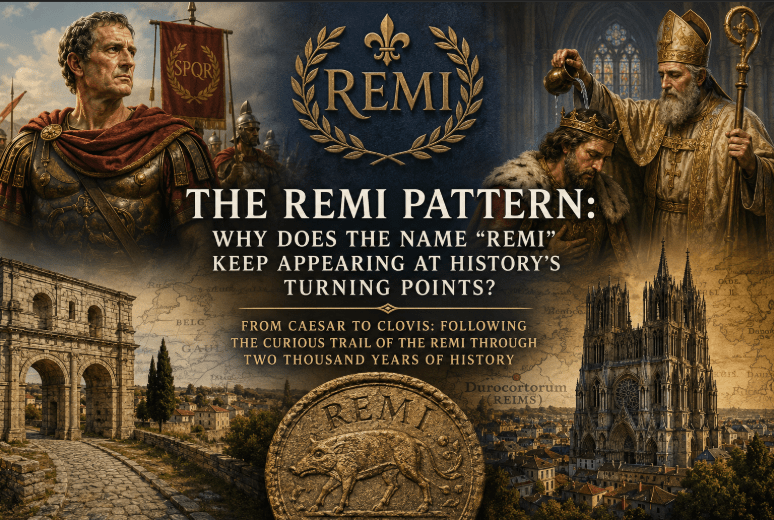
History is full of powerful empires, famous kings, and legendary battles. Yet every so often, a smaller name quietly appears at moments that would ultimately reshape civilizations.
For me, that name has been Remi.
This isn’t an argument that a single bloodline secretly controlled history. Nor is it an attempt to invent mythology where none exists. Instead, it is an observation—one that becomes increasingly difficult to ignore once you begin following the trail.
The Remi seem to have possessed an unusual ability to position themselves where history was about to change.
The First Great Example: Caesar and the Remi
The ancient Remi were a Belgic tribe living in what is now northeastern France.
Unlike most of their neighboring tribes, the Remi made one of the most consequential political decisions of the ancient world.
Instead of joining the great Gallic coalition against Julius Caesar, they allied themselves with Rome.
At first glance, this appears almost unremarkable.
But history often turns on decisions that seem ordinary in the moment.
By siding with Caesar, the Remi preserved their autonomy, retained favorable treatment, and became one of Rome’s most trusted Gallic allies. While many tribes were crushed, enslaved, or politically dismantled, the Remi continued to prosper within the Roman system.
It wasn’t merely survival.
It was strategic adaptation.
Rather than resisting inevitable change, they positioned themselves to influence it.
That decision echoes throughout later history.
The Roman Connection
The relationship between Rome and the Remi did not simply end after Caesar’s campaigns.
Their capital at Durocortorum (modern Reims) became one of the most important cities in Roman Gaul.
Roads converged there.
Trade flourished.
Administration expanded.
Christianity later found fertile ground there.
The Remi had effectively transformed from tribal leaders into influential partners within one of history’s greatest empires.
Their story illustrates something fascinating:
Sometimes influence belongs not to the largest power, but to those who recognize where power is moving.
Saint Remigius and the Birth of France
Several centuries later another familiar name emerges.
Saint Remigius (Saint Rémi).
As Bishop of Reims, he baptized King Clovis I around A.D. 496.
That ceremony is widely regarded as one of the foundational moments in French history.
Clovis’ conversion united political power with Western Christianity and helped establish the cultural identity that would eventually become France.
Again, the pattern appears.
Not necessarily military conquest.
Not domination.
Influence at precisely the right historical moment.
Whether by coincidence, continuity, or cultural inheritance, the name Remi once again stands beside a civilization-changing event.
Why Are So Many Churches Named Saint Remi?
As I continued researching, another curiosity emerged.
Across France—and even beyond—churches, abbeys, schools, and landmarks bear some variation of the name:
- Saint Remi
- Saint Rémi
- Saint Remigius
- San Remigio
This is largely because of the enormous influence of Saint Remigius after the conversion of Clovis.
Yet it also means that the name itself became woven into the cultural and religious geography of Europe.
Generations passed.
Empires rose and fell.
The name remained.
Sometimes history preserves people.
Sometimes it preserves symbols.
A Different Kind of Influence
One of the most interesting characteristics of the historical Remi is that they rarely appear as conquerors.
Instead, they appear as connectors.
Diplomats.
Builders.
Religious leaders.
Political allies.
Administrators.
Rather than standing at the center of every conflict, they often seem positioned where different worlds intersect.
Rome and Gaul.
Christianity and kingship.
Ancient tribal society and emerging nations.
Perhaps that is coincidence.
Or perhaps societies remember those who build bridges better than those who simply win wars.
Is There Really a Pattern?
Humans naturally seek patterns.
Sometimes we find meaning where none exists.
That possibility should always be acknowledged.
Yet history also rewards careful observation.
The Remi repeatedly appear during periods of extraordinary transition.
- Julius Caesar’s conquest of Gaul.
- The Roman consolidation of Western Europe.
- The Christianization of the Frankish kingdom.
- The emergence of medieval France.
- Centuries of religious and cultural influence centered around Reims.
Individually, each event has its own explanation.
Collectively, they invite a fascinating question.
Why does this relatively small name continue appearing beside such enormous historical developments?
Following the Trail
My research into the Remi began as curiosity.
It has become something much larger.
Every new source seems to uncover another connection, another historical figure, another forgotten crossroads where the name quietly reappears.
Perhaps there is no grand mystery.
Perhaps history simply remembers those who consistently chose adaptation over destruction, diplomacy over isolation, and opportunity over pride.
Or perhaps we have only begun uncovering the full story.
Either way, one lesson remains remarkably consistent.
History is not always shaped by those standing in the spotlight.
Sometimes it is shaped by those who know exactly where to stand when history changes direction.
The Remi may be one of the greatest examples of that principle.
 Remi Tribe